

You don't build it.
The frontend your visitors experience.
RockitWP's frontend is powered by Next.js — the React framework behind some of the fastest sites on the web. Server-side rendering, edge caching, image optimization. All managed by the platform. You build pages in WordPress, the frontend handles the rest.


What Next.js brings to your website.
These aren't features you configure. They're built into the platform and
apply to every page automatically.
Server-side rendering (SSR)
Every page is rendered as complete HTML on the server before it reaches the
browser. Visitors see content immediately — no blank screen while JavaScript
loads. Search engines get fully crawlable HTML.
Edge caching
Rendered pages are cached at edge nodes worldwide. A visitor in Sydney gets the page from a nearby server, not one on another continent. Fast first byte everywhere.
Automatic image optimization
Images are resized, compressed, and served in modern formats (WebP, AVIF)
automatically. Responsive srcsets, lazy loading below the fold. You upload an image — the platform handles the rest.
Incremental Static Regeneration
Pages update without a full site rebuild. When you publish or update content, only
the affected pages regenerate. No rebuild queues, no waiting for the entire site to
deploy.
Code splitting & tree shaking
Each page only loads the JavaScript it needs. No bloated bundles, no unused code. Minimal Total Blocking Time, fast time to interactive.
Zero layout shift
Every element has predictable dimensions. Content doesn't jump around as fonts
and images load. Stable, clean rendering from the first frame.
WordPress → GraphQL
→ Next.js. Already wired.
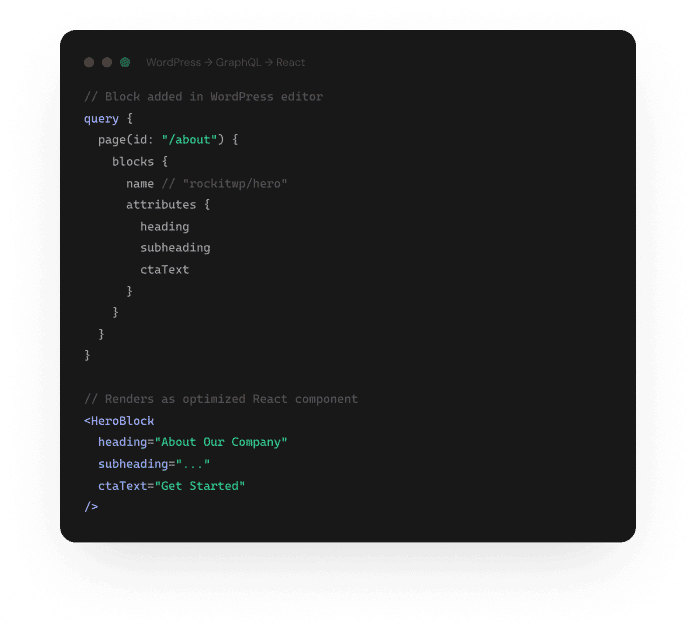
Every Gutenberg block you add in WordPress is exposed as
structured data through WPGraphQL. The Next.js frontend
queries that data and renders each block as an optimized
React component. The pipeline is pre-configured — you don't
wire anything.
1
You add a block in WordPress
A hero, a feature grid, a testimonial — any of the 30+ blocks or 260+ patterns.
2
WPGraphQL structures it
Block name, attributes, content — all become typed, queryable data.
3
Next.js renders it
The block maps to a React component. Server-rendered, edge-cached, optimized.
What you built in the editor is what visitors see.
You don't deploy,
host, or maintain it.
The Next.js frontend is part of the RockitWP platform. It's managed infrastructure
— like Cloudflare for your CDN, like Vercel for your builds. You use it because it
works.
No deployment pipeline
You don't set up CI/CD, configure Vercel or Netlify, or manage deploy previews. Publish in WordPress — the frontend updates.
No server management
No Node.js servers to provision, scale, or monitor. The platform handles compute, caching, and availability.
No framework updates
Next.js updates, security patches, dependency management — all handled by the platform. You stay current without doing the work.
The stack you'd build
yourself. Already built.
If you're a developer evaluating RockitWP, here's what you're getting under the hood.
Typed block → component mapping
Every Gutenberg block has a corresponding typed React component. Attributes
flow through WPGraphQL as structured data. No manual wiring.
SSR + ISR out of the box
Server-side rendering for every page. Incremental Static Regeneration for updated content. You don't configure getServerSideProps or getStaticPaths.
Design tokens → Tailwind
Your design token config drives the Tailwind theme. Colors, spacing, typography,
radius — defined once, applied across all components through utility classes.
Extensible blocks
Build custom Gutenberg blocks and they flow through the same GraphQL pipeline.
Create new block types for your specific use case — the rendering system picks
them up automatically.