

One platform.
WordPress backend. Next.js frontend.
RockitWP is a headless CMS built on WordPress — the platform 43% of the web already trusts. Your team edits content in Gutenberg. Your visitors get a blazing-fast Next.js site. The entire stack is managed for you.

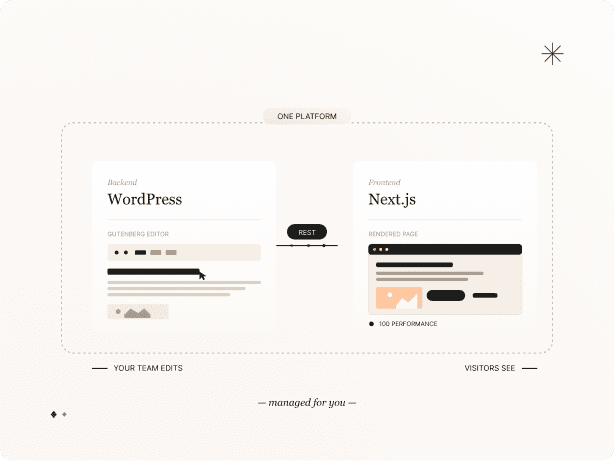
Three layers. Fully connected.
Three layers, one system. Each layer builds on the one before it.
01
WordPress CMS
The editor millions already know. Gutenberg
blocks, media library, custom post types, user roles, plugin ecosystem. Your content team works here.
02
WPGraphQL
Every block becomes structured, typed data. The frontend queries exactly what it needs — no over-fetching, no REST limitations. The pipeline is pre-configured.
03
Next.js Frontend
Server-side rendering, edge caching, automaticimage optimization. Every block renders as an optimized React component. Sub-second loads on every page.
The best of both worlds.
Without the tradeoff.
Traditional WordPress is easy to edit but slow to render. Headless CMS platforms are fast but hard to use. RockitWP gives you WordPress editing with Next.js performance — and you don't have to build the connection yourself.

Familiar editing
Your team already knows WordPress. Zero learning curve for daily content work.
Modern performance
Next.js delivers sub-second loads and 90+ Lighthouse scores on every page.
Security by architecture
WordPress admin isn't exposed to the public web. The frontend is a separate layer —
reduced attack surface by design.
Fully managed
The whole stack, hosted and fully managed. Backend, frontend, and everything in between. You build websites, not infrastructure.
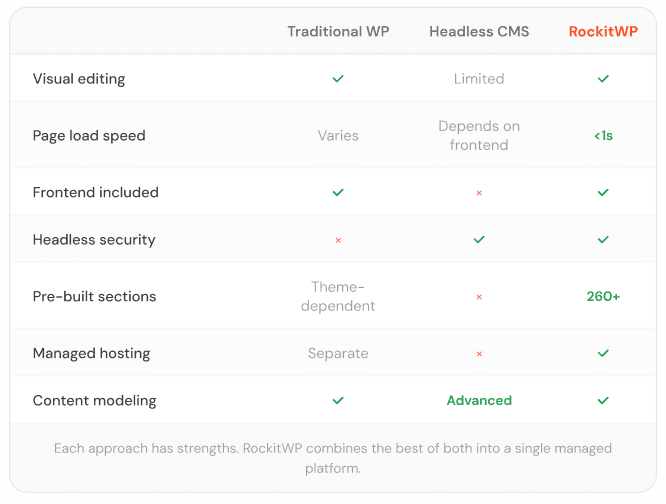
The complete stack. Not just the CMS.
Other headless platforms give you a content API and expect you to build everything else. RockitWP includes the entire stack.
Visual block editor
30+ blocks, 260+ pattern variations. Build pages visually — what you see in theeditor is 1:1 with the live site. Not forms with fields. Actual page layouts.
Next.js frontend
Server-side rendering, edge caching, automatic image optimization. Every block renders as an optimized React component. Managed and deployed for you.
Design token system
Colors, typography, spacing, radius — defined once, applied everywhere. Brand consistency enforced at the system level, not dependent on who's editing.
SEO → Next.js
Sitemaps, meta data, schema markup, Open Graph — all managed in the
WordPress editor and automatically transferred to the Next.js frontend.
Managed hosting
WordPress + Next.js + CDN + SSL. All hosted, updated, backed up, and monitored. You don't manage servers, configure caching, or handle deployment.
Instant preview
See the page as you build it in the editor. Preview before publish. What you see is what goes live — no full site rebuilds, no separate staging URL.
Not the headless
CMS you're used to.
Most headless platforms give you a content API and leave you to figure out the rest. Here's what's different.
You don't build the frontend
Other platforms: content API + build your own Next.js app + deploy it + maintain it. RockitWP: the Next.js frontend is built in and managed. You build pages, not pipelines.
You edit visually, not in forms
Other platforms: fill in title, body, image fields. Hope it looks right on the frontend. RockitWP: visual block editor where what you see is what goes live.
Editors build pages independently
Other platforms: adding a new section requires frontend code changes. RockitWP: 260+ sections available in the editor. Editors pick, customize, and publish — no developer needed.
One price for the whole stack
Other platforms: CMS subscription + hosting costs + developer time for frontend + ongoing maintenance. RockitWP: one subscription, everything included.
Built on WordPress.
Not from scratch..
43% of the web runs on WordPress. That ecosystem — plugins, integrations,
community — is your starting point, not something you leave behind.
Plugin ecosystem
Yoast SEO, ACF, WooCommerce, Gravity Forms — the plugins you already use work within the WordPress backend.
Custom post types
Products, events, team members, portfolios — create any content type with the full WordPress taxonomy system.
User roles
Admin, editor, author, contributor. WordPress's role system controls who can do what. Granular permissions built in.
REST & GraphQL APIsc
WPGraphQL powers the frontend pipeline. WordPress REST API available for integrations. Both accessible.